

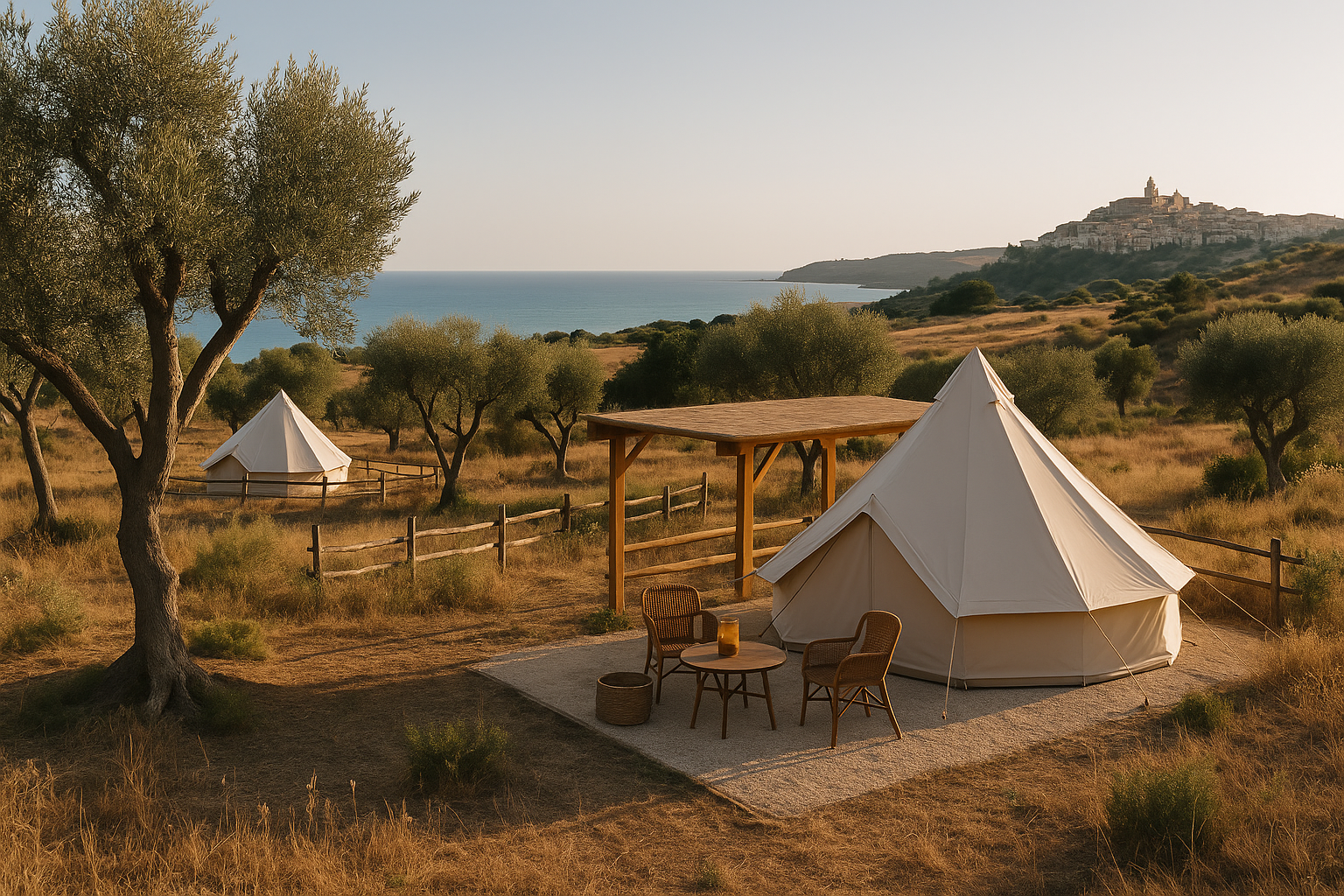
What it takes to turn glamping into a business model
Introduction
When people imagine starting a glamping site, the first question that comes up is: can this actually be a business? In Sicily, where tourism is already one of the strongest industries, the answer is yes. But it’s not only about Sicily, the principles here apply anywhere you have land, vision, and the motivation to try.
Glamping is one of those rare models where a low investment can produce the same revenue as a traditional hotel room that costs four times as much to build. That’s the big advantage: you can test the waters with just one tent and scale from there.
If you’re completely new to this idea, you may also want to read our earlier guide: Start glamping in Sicily: simple steps from land to guests.
How many tents do you need?
The beauty of glamping is that you can technically start with just one tent. In high season, a single tent can bring in €100–150 a night (or even more if paired with special experiences). That’s enough to create a nice extra income if you’re hosting in your own backyard or as a seasonal side project.
But if you want to turn glamping into a standalone business, four tents is usually the minimum to make it viable. With four tents, you can already host groups, generate consistent bookings, and justify the effort of setting up bathrooms, kitchens, and common spaces.
For advice on choosing your first tent, check out: Choosing the perfect bell tent for glamping in Sicily.
Investment: tents, bases, and infrastructure
A typical tent setup includes three things: the tent itself, a solid base, and furnishings.
- Tent: €800–2,500 (average around €1,400).
- Base: €0–3,000 (from compacted gravel to full wooden decks).
- Furnishings: ~€1,000 (beds, rugs, basic furniture).
That means each tent setup comes in around €2,500–€5,500, depending on how creative and resourceful you are.
What about bathrooms and kitchens? This is where the range becomes wide.
- On the very low end (~€500): a removable compost toilet, a gravity-fed water tank, a hose shower, and a simple kitchenette with a counter, gas hob, and a few pans.
- On the high end (tens of thousands): fully built outdoor kitchens, tiled bathrooms, or even event-style bathroom trailers.
We’ll dive into creative, budget-friendly hacks in the next blogpost, but for now, it’s important to understand the range — and know that you can already start simple.
For inspiration on how to design simple yet solid bases, read: Building a solid base for a bell tent on sloped land.
Sample numbers: how the math works
Let’s say you set up 4 tents with an average nightly rate of €120.
- 120 nights/year (roughly 3 months of full high season plus weekends on the shoulders).
- 4 tents × 120 nights × €120 = €57,600 gross/year.
If your setup is more upscale (farm experience, pool, kids’ activities, or unique design), you could charge €140–€160 per night. At €160:
- 4 tents × 120 nights × €160 = €76,800 gross/year.
That’s with just four tents — often on land that would otherwise sit unused.
Operating costs: what to expect
- Cleaning: €20–40 per turnover (or free if you do it yourself).
- Maintenance: ~€1,000 per tent per year after the first year.
- Laundry: can be done in-house with a simple washing machine.
- Marketing: 5–10% of revenue (higher at the start).
- Electricity: small solar generator per tent (~€800) or larger systems for kitchens (~€2,000).
- Water: truck-filled tanks with gravity feed is the simplest solution.
In other words, costs can be kept surprisingly low, especially in the first year.
Permits and business formats
This is where things get more complex — but also where you have options. In Sicily (and most of Italy), there are several ways you can frame your glamping project:
- Camping or hotel format
- Requires full tourism licensing.
- Strict rules on water quality, wastewater, electricity, hygiene.
- Best suited for larger, long-term projects.
- Agriturismo model
- Possible if your land is agricultural and your main income is farming.
- You can host a limited number of guests per hectare (e.g. one unit per hectare).
- Requires that your main business remains agriculture.
- Holiday home permits
- Each tent counts as an “individual unit.”
- You apply for a rental license number, often with municipal inspections.
- Private retreat model
- Accommodation is secondary to the service (yoga retreat, workshop, event).
- Operates in a gray area, since you’re not officially running an “accommodation business.”
- Friends & family network
- Hosting within your own circle, often without advertising.
- The most informal path — not sustainable as a public business, but a way to test.
Which option fits best depends on your land, your network, and your willingness to go through bureaucracy.
This is the information I’ve gathered so far, partly from speaking with someone who worked as a delegate for tourism in the town hall of Siculiana, where I live. We’ll be running our own tests over time to see what’s possible, and I’ll keep documenting the process as we go. It’s likely that many local officials haven’t dealt with the concept of glamping before, so some patience and clear explanation may be part of the journey.
If you’d like to see a smaller-scale example of how a tent can already be used for retreats, read: From land to retreat: creating multifunctional spaces.
Why glamping is worth it
We’re moving into a future where life is increasingly digital and automated. People will crave the opposite: experiences close to nature, simplicity, community, and silence.
That’s where glamping comes in. With relatively little investment, you can create a place that feels rare and valuable in today’s world. And in Sicily, where this concept is still new, the potential is wide open.
Glamping has one of the lowest barriers to entry in hospitality. For the cost of setting up a single tent, you can charge the same as a hotel room — and then expand from there.
My perspective as a consultant
Every project is unique. Some people want a fully legal, structured setup from the start. Others are comfortable beginning in the gray area and adapting later. My role is to help you:
- Assess your land.
- Run numbers that fit your reality.
- Explore creative solutions to deal with permits and infrastructure.
I love finding ways to make things work — sometimes conventional, sometimes creative, but always practical. And it always depends on your own situation and your own tolerance for risk.
Final thoughts
The most important advice? Just get started.
You don’t need everything figured out. Set up one tent, test the experience, and see where it leads.
Glamping has one of the lowest barriers to entry in hospitality. For the cost of setting up a single tent, you can charge the same as a hotel room — and then expand from there.
So if you’ve been thinking about it, don’t wait. Try it. Build small, learn, and let the journey shape itself.
✨ For more visual inspiration, check out our Pinterest board.
📩 Ready to explore your own project? Reach out for consulting, browse our bell tent options, or send me a quick message on WhatsApp to discuss your ideas.